Doughs:
Sauces:
MAKE THE DOUGH
Make your dough of choice and let it rest, tightly covered, at room temperature for 20 to 30 minutes.
SET UP YOUR WORKSPACE
Dust a sheet pan with semolina or line it with a dry dishcloth. Gather your tools.
ROLL THE DOUGH INTO A ROPE
Cut off a slice of dough, about the width of one or two fingers. Keep the rest covered.
Roll the dough into a rope, a scant ½ inch (1.25 cm) thick (about the thickness of a Sharpie marker): Start in the center and use your fingers or the palms of your hands to roll the dough, first back and forth, until the surface is smooth, and then outward in opposite directions, eventually making your way toward the ends. If the dough slides and it’s difficult to get a grip, wet your hands a little and try again. The rope does not need to be perfectly even.
CUT THE ROPE INTO PIECES
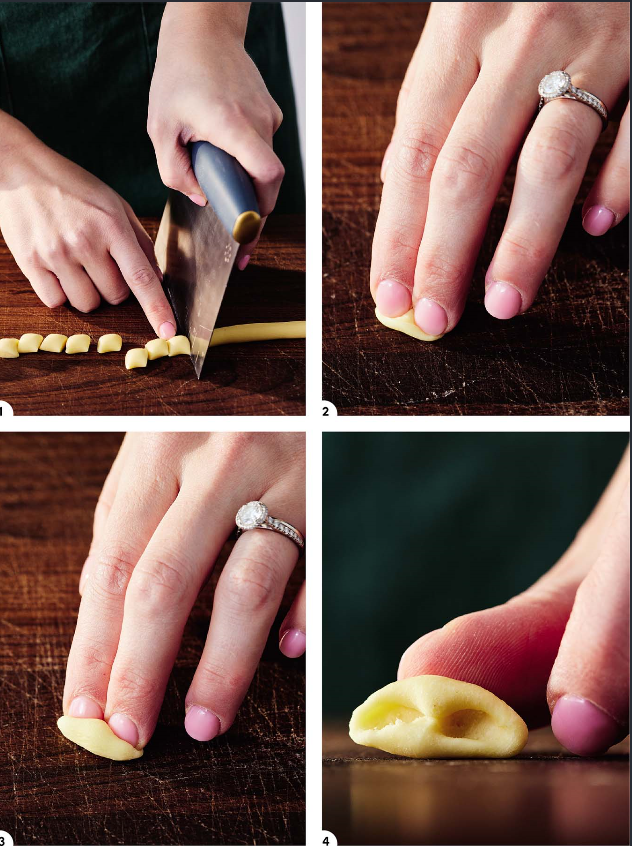
Cut the rope into ½-inch (1.25-cm) pieces, about the size of chickpeas.
MAKE THE CAVATELLI
For smooth cavatelli, place your index and middle fingers at the top edge of one of the dough nuggets (the orientation of the dough doesn’t matter, though I usually position the cut sides horizontally). Firmly press down, then drag the dough toward you, with generous pressure, until it curls over and forms a little cave. Don’t be shy; you want to feel tension between your fingers and the dough. The more pressure you use, the hollower it will be, and the more sauce the pasta can grab.
If you’re unhappy with the results (perhaps it’s very thick, or smeared across the board), smush it into a little ball and try again. But don’t get bogged down in the details because each piece is meant to be unique.
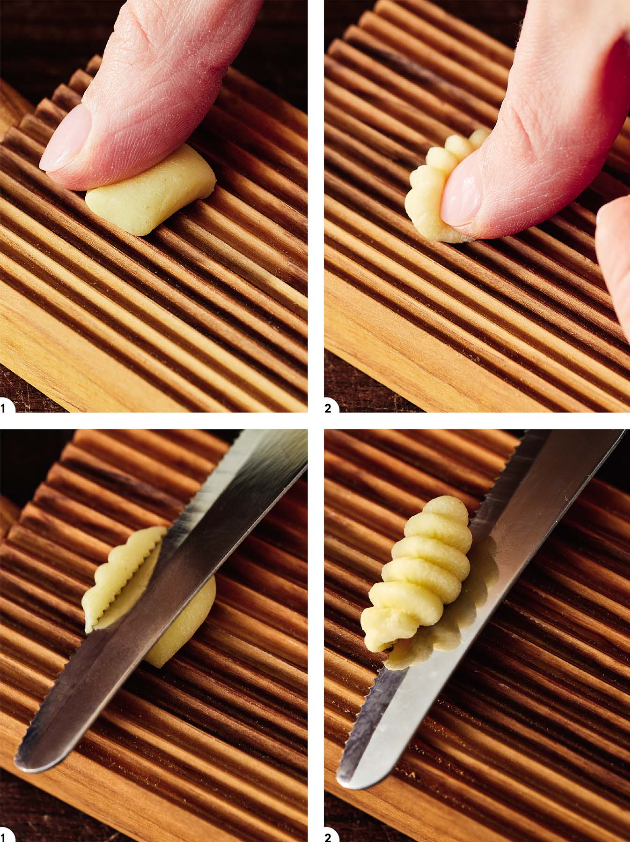
To use a gnocchi board or other textured surface, position a nugget of dough near the edge of the board closest to you (near the handle, if it has one). Then press the side of your thumb into the near edge of the dough and push it away from you, with firm pressure, until it curls over once and is deeply imprinted with ridges on the outside. If you prefer, use the serrated edge of a table knife or the blade of a bench scraper to drag the dough across the board instead, like spreading butter on bread (some find this option easier, and more satisfying).
Note: The most obvious choice is to roll the dough across the back of a fork. You can absolutely do this, but in my house a fork doesn’t provide a long enough “runway” to fully roll the pasta, resulting in denser dumplings.
Arrange the finished cavatelli in a single layer on the prepared sheet pan. Repeat with the remaining pieces, and then the remaining dough. You can leave the pasta uncovered at room temperature until you’re done, for up to 5 hours.
COOK THE PASTA
Cook the cavatelli until tender but with some bite, 3 to 5 minutes, depending on their thickness and drying time.